Eric Turns on the Television
The Cabin at the End of the WorldEric Turns on the Television in a moment when looking away has become almost as consequential as watching. After Leonard insists that the family must learn whether Wen’s death has stopped the predicted end of the world, a fly lands on the screen and Eric’s hand finds the set’s nearly invisible power button. The images that follow connect the cabin’s immediate crisis to a wider sequence of reported disasters, but they do not give the family an easy answer: the television offers evidence, while Leonard’s claim that events prove the need for sacrifice remains an interpretation imposed on that evidence.
Background: Television as a Test
The television has already become part of the conflict inside the cabin. During an earlier broadcast, Leonard points the remote at Andrew and insists that he watch and listen. The program reports a 7.9-magnitude earthquake in the Aleutian Islands, which had struck more than four hours before the report. That detail gives the disaster a specific place and a delay between event and coverage, rather than presenting it as an abstract prophecy.
The news then describes the danger of a tsunami. The U.S. National Tsunami Warning Center has issued an advisory for British Columbia and more than a thousand miles of the American Pacific Northwest coast, including Seattle and Portland. The Pacific Tsunami Warning Center issues its strongest warning for Hawaii, where residents and tourists on north-facing coasts are ordered to evacuate to higher ground. A spokesperson explains that tsunami-detection buoys have registered a wave estimated at fifteen to twenty feet.
The broadcast shows a resort on Kauai after its evacuation: gray, debris-filled water rushes over the beach, through the pool and courtyard, and into lower rooms. Other footage shows boats capsized, marinas flooded, and roads washed out. The spokesperson says early warning gave people time to leave; at that point, no injuries or deaths have been reported. The images establish real damage while also emphasizing that the warning system has prevented reported casualties. They complicate Leonard’s effort to treat catastrophe as a simple, predetermined consequence.
The news grows more alarming when a second earthquake, registering 8.6 on the Richter scale, strikes seventy miles off the Oregon coast in the Cascadia Subduction Zone. Leonard takes the report as confirmation that the family should have chosen a sacrifice. His certainty falters even as he insists on it: he first reacts with satisfaction that the predicted event has arrived, then appears pained by what he has witnessed. The television has become the means by which he argues that the family’s refusal caused the disasters.
The Switch and Its Immediate Images
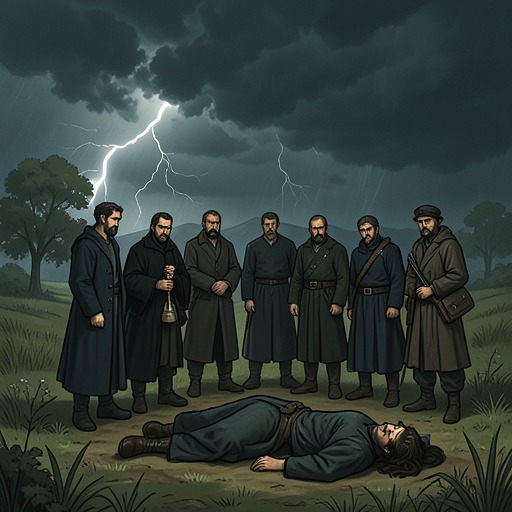
Later, after Adriane’s death, Leonard again demands that the television be turned on. He recalls that after Redmond died, the group watched the news and saw cities drowning, as he had said they would. Now, he says, they must find out whether what happened in the cabin has stopped the next predicted disaster. He specifically raises the possibility that Wen’s death might be enough, then admits that the sacrifice may not count: according to the rule he has described, it must be willing, and the family was supposed to choose someone themselves.
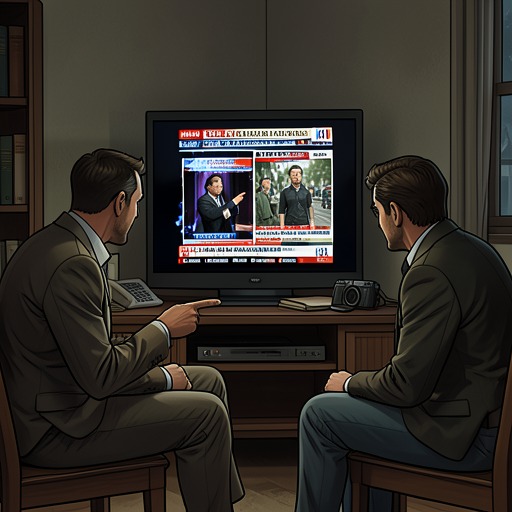
Eric has said that they are leaving, and Andrew warns him not to listen to Leonard. Then one fly lands on the lower-right corner of the screen and crawls in looping, sideways patterns. Eric reaches toward it; the fly guides his hand to the power button, hidden along the inside edge of the television’s plastic frame and smaller than his fingertip. He presses it. The action is presented without a clear moment of deliberation: Eric does not recall deciding to turn the set on, and when Andrew asks why, he can only explain that there was a fly.
After a short delay, the screen fills with rapidly changing images and scrolling text. Eric initially cannot make them out. Overhead views of an airport give way to a hospital, where doctors wear protective shields and gowns, and then to crowded sidewalks, markets, and packed subways. Many people wear surgical masks. The sequence overwhelms Eric with its color, sound, and pace; he squints, retreats from the television and couch, and bumps into Andrew. The broadcast’s visual assault is not just another item of information: it physically drives Eric away even as Andrew turns him back toward the immediate question of why he acted.
Hong Kong and the Plague Report
The images resolve into a program about Hong Kong. One view includes the Blue House in Wan Chai, a building Andrew remembers from a trip with Eric. Its ground floor houses the Hong Kong House of Stories, which the couple visited on their last morning in the city before heading north to Hubei Province. At home, photographs of the Blue House and Jardine House hang above their computer desk. These personal references make the report’s city more than a distant setting: its images overlap with places the family has visited and preserved in photographs.
The program is identified as City Zero: Hong Kong and the Fight Against Bird Flu. A reporter stands in Kowloon City Wet Market with her surgical mask lowered around her neck. The report describes a surge in human H7N9 cases in Hong Kong since January, with a mortality rate approaching forty percent. It also reports that millions of chickens and ducks have been culled across the region, that quarantines may affect the hardest-hit Hong Kong neighborhoods, and that open-air markets may close. Dead birds carrying the strain have also been found in Suffolk, England, Germany, and at a chicken farm in Tennessee, raising fears of a pandemic.
The story’s force comes partly from its familiar geography and partly from the difference between forms of television content. The earthquake and tsunami coverage includes warnings, a spokesperson, and footage whose live or recorded status is not always clear; the Hong Kong material is presented as a named program with a reporter and a sequence of city images. Neither form removes the uncertainty inside the cabin. Eric’s involuntary-seeming action brings the report into view, but the broadcast itself does not establish that the deaths in the cabin satisfy Leonard’s sacrificial rule.
Recurrence and Consequence
The television’s role continues after this scene. Later, after Leonard has been killed, the set is unmuted and breaking news interrupts the bird-flu program. The screen shows smoking airplane wreckage, debris scattered across fields, and pieces of a plane floating near the shore. Eric stands to see more clearly while still holding Wen. The report extends the pattern of catastrophe beyond the earthquakes, tsunami, and disease coverage, while the image of Eric holding his daughter keeps the broadcast’s worldwide scale in tension with the family’s immediate loss.
Across these scenes, turning on the television is an action with consequences but not a clean resolution. Leonard uses broadcasts to argue that the disasters validate his prophecy and that the family must accept a sacrifice. The reports supply concrete events—the Aleutian earthquake, flooding in Hawaii, the Cascadia earthquake, the Hong Kong outbreak, and later plane crashes—while their changing formats and uncertain timing leave room for doubt about what the images can prove. Eric’s turn to the screen therefore exposes the family to more evidence without settling whether the catastrophes are punishment, prediction, or proof of a required sacrifice.